
Overview
The Automatic Workflow feature in SupportCandy helps automate repetitive ticket management tasks. It uses Triggers, Conditions, and Actions to perform tasks automatically when specific ticket events occur.
Where to Find
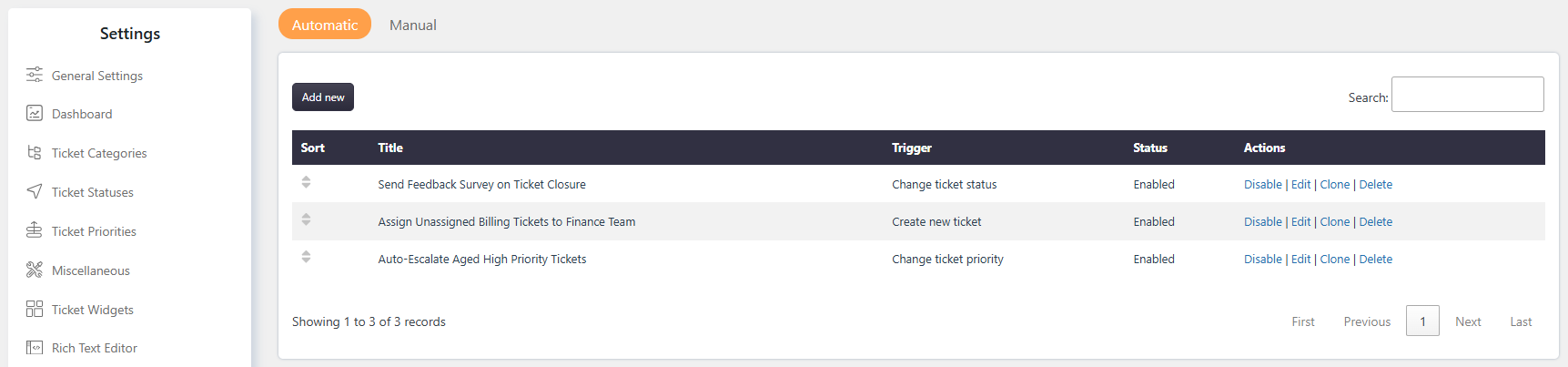
Go to Support → Settings → Workflow → Automatic.
How It Works
An Automatic Workflow follows three main steps:
- Trigger – Defines the event that starts the workflow.
- Conditions – Defines the rules that the ticket must meet.
- Actions – Defines what the workflow should do when the conditions are satisfied.
When the selected trigger occurs, SupportCandy checks the conditions. If the conditions match, the configured actions are performed automatically.
Step-by-Step Guide
- Go to Support → Settings → Workflow → Automatic.
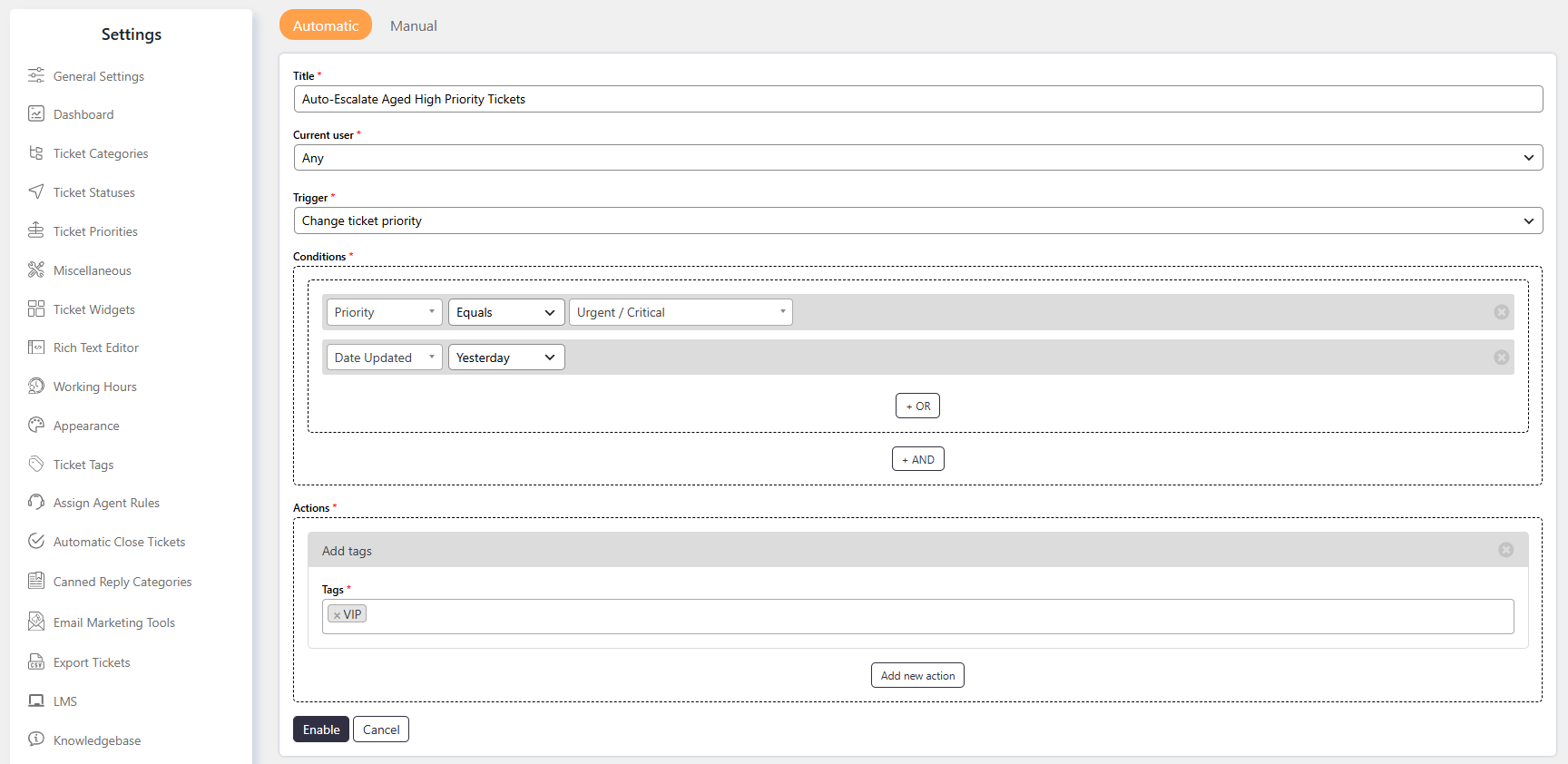
- Add a new workflow.
- Enter the workflow name and description.
- Select a Trigger.
- Add the required Conditions.
- Define the Actions to perform.
- Save the workflow.
Triggers
A Trigger is the event that starts an Automatic Workflow.
Available triggers include:
- Create New Ticket – Runs when a new ticket is created.
- Ticket Reply – Runs when a reply is added to a ticket.
- Submit Private Note – Runs when a private note is added.
- Change Ticket Subject – Runs when the ticket subject changes.
- Change Ticket Category – Runs when the ticket category changes.
- Change Ticket Priority – Runs when the ticket priority changes.
- Change Ticket Status – Runs when the ticket status changes.
- Change Assignee – Runs when the ticket is assigned, reassigned, or unassigned.
- Change Ticket Fields – Runs when a ticket field is updated.
- Change AgentOnly Fields – Runs when an AgentOnly field is updated.
- Feedback Added – Runs when feedback is added to a ticket.
Example
- Condition: Status is Open and Priority is High.
- Result: The workflow continues only when both conditions are satisfied.
Conditions
Conditions determine whether the workflow should continue after the trigger occurs.
You can create conditions using:
- Ticket fields, such as Status, Category, Priority, and Subject.
- Custom fields, including AgentOnly fields and customer-related fields.
Available operators include:
- Equal to – Matches an exact value.
- Matches – Checks whether the field matches one or more specified values.
- Has word – Checks whether specific words exist in a field.
Example
If you want customers to keep the same ticket status after replying, set Ticket Status After Customer Reply to Do not change.
If you want to rename tickets as cases, set Ticket Prefix to Case. Tickets will then appear as Case #1234.
Actions
Actions define what SupportCandy does when the conditions are satisfied.
Available actions include:
- Add Reply – Adds a reply to the ticket automatically.
- Add Private Note – Adds an internal note for Agents.
- Change Subject – Updates the ticket subject.
- Change Status – Changes the ticket status.
- Change Category – Changes the ticket category.
- Change Priority – Changes the ticket priority.
- Change Assignee – Changes the assigned Agent, adds an Agent, or removes all assigned Agents.
- Change Additional Recipient – Replaces the additional recipients or removes all additional recipients.
- Change Ticket Fields – Updates selected ticket fields.
- Change AgentOnly Fields – Updates fields visible only to Agents.
- Change Customer Fields – Updates customer fields.
Examples
Example 1: Auto-Assign High Priority Tickets
- Trigger: Create New Ticket
- Condition: Priority is High
- Actions:
- Assign the ticket to the Senior Support Team.
- Change the ticket status to In Progress.
- Add a private note stating that the ticket requires immediate attention.
Example 2: Auto-Close Resolved Tickets
- Trigger: Out of SLA
- Condition: Status is Resolved
- Actions:
- Add a reply informing the customer that the ticket has been closed.
- Change the ticket status to Closed.
Notes / Tips
- Use a clear Trigger that matches the event you want to automate.
- Add Conditions to prevent actions from running on unrelated tickets.
- You can add multiple Conditions and Actions to one workflow.
- Review workflow conditions carefully before enabling automation.
- Automatic Workflows help reduce repetitive work and keep ticket handling consistent.